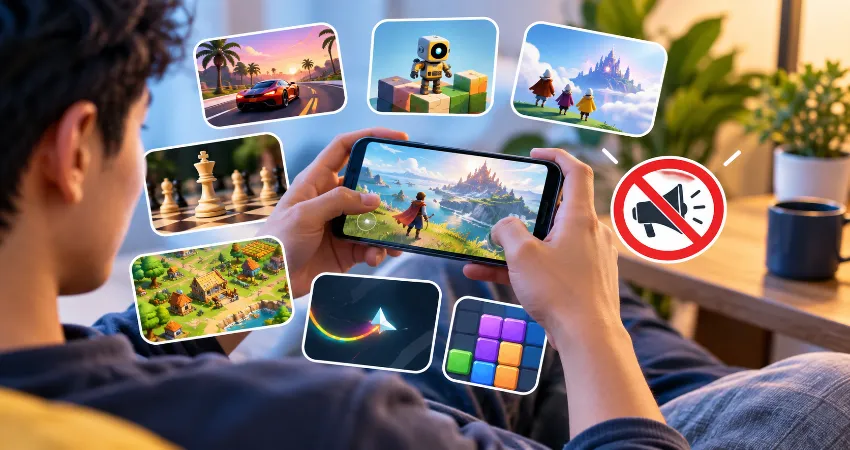
Free mobile games can be surprisingly expensive in another currency: your attention. A game may cost nothing to install, yet interrupt a five-minute session with full-screen promotions, reward prompts, store reminders, and repeated requests to watch videos. That can turn a relaxing game into something that feels more like navigating menus than actually playing.
The good news is that some developers take a much cleaner approach. After comparing current developer information, mobile store listings, monetization models, offline features, and the way optional purchases are presented, several games stand out for respecting the player’s time. Some are completely free of advertising, while others use optional promotions without constantly interrupting normal play.
The most useful way to judge these games is not simply to ask whether an app technically contains advertising. A better question is: Can you play normally without being repeatedly interrupted? That practical difference is the focus of this guide.
What Makes a Free Mobile Game Feel Ad-Friendly?
A pleasant free game keeps the main gameplay loop separate from monetization. You should be able to start a level, finish a match, solve a puzzle, or explore the game without repeatedly closing promotional screens. Optional purchases are not automatically a problem either. A game that sells extra content through a quiet store menu can provide a much better experience than one that interrupts every few minutes.
Offline support is another positive sign. Games designed to work without a constant connection often rely less heavily on advertising systems. Open-source projects and games supported by optional purchases or community donations can also offer unusually clean experiences.
1. DATA WING
DATA WING is one of the easiest recommendations for players who want a polished mobile game without constant commercial distractions. It combines fast two-touch racing with a surprisingly developed story spread across more than 40 levels. Google Play currently lists the game as free and highlights offline play, while the App Store also offers it as a free download.
The strongest part of DATA WING is how quickly it gets out of the way. The controls are simple, restarting a challenge is quick, and the interface does not overwhelm the racing itself. It is particularly good for players who want something that feels like a complete small game rather than an endless collection of daily tasks.
2. Simon Tatham’s Puzzles
If avoiding advertising is your highest priority, Simon Tatham’s Puzzles deserves a place near the top of the list. The Android version includes 40 different logic puzzle types, generates new puzzles on demand, works offline, and is explicitly described by its developer as free with no ads.
The presentation is functional rather than flashy, but that simplicity is part of the attraction. There are no elaborate reward systems demanding attention. You choose a puzzle, select a difficulty, solve it, and move on. Because puzzles are generated rather than limited to a fixed collection, the app has excellent long-term value for players who enjoy logic challenges.
3. Unciv
Unciv is an impressive option for Android users who prefer deep strategy. It is an open-source civilization-building game that its developer describes as free forever and free from ads. The Google Play listing was still actively updated in 2026, making this more than an abandoned curiosity from an older generation of mobile games.
Instead of impressive 3D graphics, Unciv concentrates on systems such as city development, research, expansion, diplomacy, units, and long-term planning. That makes it especially attractive on modest devices. The interface takes some learning, but players looking for substantial strategy without constant commercial interruptions get an enormous amount of gameplay here.
4. The Battle of Polytopia
The Battle of Polytopia offers a more visually polished approach to turn-based civilization strategy. Its developer specifically explains that the game was designed to be free from ads and instead supports continued development through optional in-app purchases. The mobile versions are free to download.
The free content is enough to understand the core experience: explore a compact map, develop technology, expand territory, and make increasingly important strategic decisions. Additional tribes can be purchased, but ordinary play is not constantly stopped by promotional videos. For many players, this is a fairer compromise than a game that gives away everything while interrupting every session.
5. Lichess
Chess players should look closely at Lichess. The service is powered by volunteers and donations, and its official mobile listings describe it as free, open source, and 100 percent free to use. Features include online matches, computer opponents, puzzles, game analysis, studies, tournaments, offline puzzle solving, and a chess clock.
Its biggest advantage is that the core experience is about chess rather than unlocking artificial mobile-game progression. You can open the application because you actually want to play or study. Advanced players also benefit from analysis tools that would often be placed behind a subscription in competing applications.
6. Sky: Children of the Light
Children of the Light proves that a free game can be visually ambitious without depending on constant advertising interruptions. It is a social exploration adventure built around traveling through atmospheric environments, meeting other players, collecting cosmetics, and participating in seasonal activities. Both Google Play and Apple’s App Store list it as free with optional purchases.
Sky does have a substantial cosmetic economy, so players who dislike stores entirely may prefer something like DATA WING or Simon Tatham’s Puzzles. However, its purchases revolve largely around cosmetics, passes, currency, and limited-time items rather than conventional advertising breaks. The developer also states that these purchases are not required to enjoy the game.
7. Argon 2D: Prelude
Argon 2D Prelude is worth discovering if you enjoy minimalist arcade games. Its current Google Play description makes an important distinction: it has no forced ads, while optional reward ads can be activated by the player.
That model is significantly less disruptive than automatically showing a video between attempts. The game combines fast movement, abstract visuals, story elements, and smooth performance. It is particularly suitable for short sessions because failing and restarting does not need to become an excuse for another mandatory interruption.
8. Mekorama
Mekorama is a charming mechanical puzzle game in which you guide a small robot through miniature 3D environments. Google Play does disclose that the game contains ads and in-app purchases, so it should not be described as completely ad-free. However, player feedback on the store commonly describes the advertising as relatively restrained compared with aggressive free-game designs.
The real attraction is the puzzle design. Rotating compact structures and discovering a route to the destination creates a relaxed pace that works naturally on a touchscreen. There is also a level-building system, which significantly extends the amount of content beyond the included stages.
How to Find Less Intrusive Free Games Yourself?
Before downloading a free game, check the store information instead of relying only on screenshots. Look for separate labels for advertising and in-app purchases. Read several recent reviews and search specifically for comments about forced videos, interruptions, store prompts, and offline usability.
Also consider how the developer earns money. Donation-supported projects, open-source games, optional expansion models, and cosmetic purchases can often support development without interrupting every session. Most importantly, judge the first 15 to 20 minutes of play. If a game is already pushing multiple screens, currencies, limited offers, and repeated prompts during the introduction, the experience rarely becomes simpler later.
Which Game Should You Choose?
For a short story-driven experience, DATA WING is an excellent starting point. Logic puzzle fans should try Simon Tatham’s Puzzles, while Unciv provides remarkable depth for Android strategy players. The Battle of Polytopia is easier to recommend when presentation matters, and Lichess is ideal for anyone interested in chess. Sky offers the richest social exploration experience, while Argon 2D demonstrates how optional reward advertising can be implemented without taking control away from the player.
Frequently Asked Questions
1. Are there really free mobile games without ads?
Yes. Some developers use donations, optional purchases, open-source development, or paid versions on other platforms to support their work. Simon Tatham’s Puzzles and Unciv are strong Android examples whose current developer descriptions explicitly state that they do not include ads.
2. Does free always mean a game will contain pop-ups?
No. Free describes the installation price, not the monetization design. Some free games have almost no commercial interruptions, while others build much of their interface around promotions. Checking the business model is therefore more useful than checking the download price alone.
3. What is the best free game for offline play?
DATA WING and Simon Tatham’s Puzzles are particularly convenient offline choices. Unciv also provides substantial single-player value, while The Battle of Polytopia supports offline gameplay. The best choice depends on whether you prefer racing, puzzles, or strategy.
4. Are optional purchases as annoying as ads?
Not necessarily. Optional purchases can remain inside a store that you never need to open. This is generally less disruptive than automatic full-screen advertising between levels. The important issue is whether purchases interrupt normal gameplay or remain genuinely optional.
5. Which game on this list offers the most strategy?
Unciv provides the deepest traditional civilization-style systems, including research, cities, expansion, units, and long campaigns. The Battle of Polytopia offers a more streamlined alternative that is easier to learn and better suited to shorter mobile sessions.
6. Which option is best for quick five-minute sessions?
Simon Tatham’s Puzzles works exceptionally well for short sessions because you can choose a small puzzle and stop whenever necessary. DATA WING is also convenient when replaying individual stages, while Lichess provides quick puzzles when there is not enough time for a complete match.
7. Are these games suitable for older phones?
Requirements vary, but lightweight titles such as Simon Tatham’s Puzzles, Unciv, and many simple puzzle games are generally better choices for modest hardware than large 3D social adventures. Always check the current operating-system requirements and storage size before installation.
8. How can I tell whether an Android game contains ads?
Google Play normally displays monetization information on the store listing. However, the label alone does not explain how frequently advertising appears. Recent reviews and the developer’s description can help determine whether ads are automatic, optional, or connected only to particular rewards.
9. Should I avoid every game that contains optional reward ads?
No. Player-controlled reward advertising is different from forced interruptions. If you can ignore the option completely and continue playing normally, the game may still provide a comfortable experience. Argon 2D is a useful example of this distinction.
10. What should I uninstall if a free game becomes too intrusive?
If normal gameplay repeatedly requires closing promotional screens, watching unwanted videos, or navigating store offers, there is little reason to keep it when cleaner alternatives exist. Mobile gaming should respect limited free time. Removing an intrusive game also prevents sunk time from becoming the only reason you continue using it.
Conclusion
The best free mobile games are not necessarily the ones giving away the most content. They are the ones that respect the player’s attention. DATA WING, Simon Tatham’s Puzzles, Unciv, The Battle of Polytopia, Lichess, Sky, Argon 2D, and Mekorama demonstrate several different ways developers can provide free access without allowing commercial interruptions to dominate the experience.
Check the current store listing before downloading, choose a monetization model you are comfortable with, and spend your mobile gaming time actually playing.