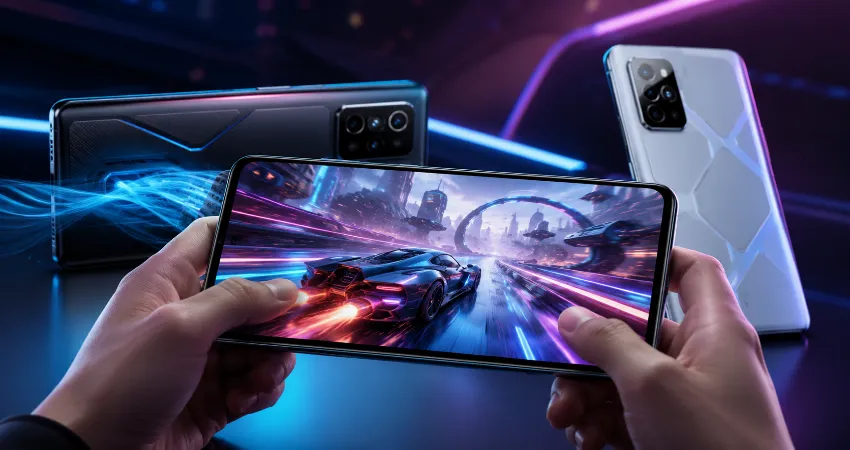
If gaming performance were the only thing influencing my next smartphone purchase, my shortlist would look very different from a normal best-phone list. I would care much less about portrait photography, ultra-thin designs, AI editing tools, or whether the phone looks elegant beside a laptop. My priorities would be sustained frame rates, cooling, responsive controls, battery endurance, charging speed, and a display capable of making high-performance games actually feel different.
That distinction matters because nearly every modern flagship phone feels fast for the first few minutes. The real test starts after the processor has been working hard for 20, 30, or 60 minutes. Heat builds up, power consumption increases, and some phones begin reducing performance. A gaming-focused buying decision therefore needs to look beyond peak benchmark scores.
Based on the hardware available right now, these are the phones I would put at the top of my list if gaming performance mattered more to me than everything else.
My First Choice: REDMAGIC 11S Pro
If I wanted the most uncompromising gaming-focused Android phone, I would start with the REDMAGIC 11S Pro. It uses the Snapdragon 8 Elite Gen 5 Leading Version, with CPU frequencies reaching up to 4.74GHz, combined with REDMAGIC’s dedicated gaming hardware and active cooling system. It is the kind of phone designed around demanding gaming rather than merely being a powerful flagship that can also play games.
The important advantage is sustained performance. Independent testing found that the 11S Pro could maintain 120fps remarkably well in demanding real-world gaming scenarios. That makes it particularly attractive for players who care about long sessions rather than five-minute performance tests. There is a major tradeoff, however: extreme synthetic workloads pushed the handset to unusually high temperatures. In practical games the temperatures were considerably more reasonable, but buyers who regularly play in hot environments should still take thermal comfort seriously.
For me, that tradeoff is acceptable only because this list is specifically about maximum gaming performance. If cameras, polished software, or everyday comfort carried equal weight, I would move other phones ahead of it.
OnePlus 15 Is the Gaming Phone I Could Use Every Day
The OnePlus 15 would probably be my choice if I wanted near-gaming-phone performance without carrying something that feels completely dedicated to gaming. It combines the Snapdragon 8 Elite Gen 5 platform with LPDDR5X memory, UFS 4.1 storage and a display capable of reaching 165Hz in supported gaming scenarios. It also carries a substantial 7,300mAh battery and supports 120W wired charging.
This combination matters more than an isolated benchmark result. A large battery gives demanding games more room to consume power without turning every session into a search for a charger. Fast charging is equally practical if you play several sessions throughout the day. OnePlus also puts significant attention into its gaming software, including scheduling and rendering technologies intended to improve frame consistency.
For someone who wants one phone for work, communication and serious gaming, this is arguably the safest choice on my list. It gives up some of REDMAGIC’s specialist hardware but gains a more conventional flagship experience.
Samsung Galaxy S26 Ultra Is My Mainstream Android Pick
I would choose the Galaxy S26 Ultra if I wanted high gaming performance but was unwilling to buy a dedicated gaming handset. Samsung uses the Snapdragon 8 Elite Gen 5 for Galaxy and has improved its thermal system with a redesigned vapor chamber and thermal interface materials. Samsung says the updated cooling arrangement provides 21 percent greater thermal performance than its previous solution.
The biggest reason to consider it is consistency outside gaming. You still get the familiar premium Galaxy experience, strong display technology and broad everyday functionality while retaining enough processing power for demanding Android games. The downside is that you are paying for many camera and productivity features that do not improve frame rates.
If gaming were literally my only concern, I would spend the money elsewhere. If gaming were my biggest concern but not my only concern, the S26 Ultra would become much more attractive.
iPhone 17 Pro Is Still the iOS Gaming Choice
For someone committed to iOS, I would look at the iPhone 17 Pro or the larger Pro Max. Apple’s A19 Pro includes a six-core GPU and hardware-accelerated ray tracing, while this generation also introduced improved thermal management that makes sustained performance more relevant than on earlier Pro models.
The iPhone’s gaming appeal is not simply benchmark speed. Apple has a strong library of well-optimized games, and some graphically ambitious titles have received particularly strong iPhone support. The Pro models are therefore appealing when game availability and optimization matter as much as hardware specifications.
I would still prefer a specialist Android device for customization, high-refresh gaming and gaming controls. However, if my purchased games, accessories and services already lived inside Apple’s ecosystem, changing platforms purely for a higher benchmark score would make little practical sense.
POCO F9 Ultra Is the Performance-Value Option I Would Watch
The recently launched POCO F9 Ultra deserves attention because it pairs the Snapdragon 8 Elite Gen 5 with a 6.9-inch high-refresh OLED display and an unusually large 8,050mAh battery. Recent reviews have highlighted its flagship-level speed and aggressive value compared with many traditional premium phones.
Its appeal is straightforward: spend more of the hardware budget on performance, display and battery instead of paying mainly for brand prestige. I would still investigate regional availability, software support and thermal behavior before buying one, particularly because demanding gaming can expose differences that normal app benchmarks do not show.
Why I Would Not Automatically Buy the Phone With the Highest Benchmark?
A benchmark score is useful, but it represents only part of the gaming experience. I would rather have a phone producing a stable 110 to 120fps for a long session than one reaching an impressive peak before quickly reducing performance because of heat.
I would therefore check sustained GPU testing, real-game frame-rate measurements, surface temperature, battery consumption and whether the games I actually play support the phone’s highest refresh rates. This approach prevents paying for performance that exists mainly on a specification sheet.
The Features I Would Prioritize Before Buying
My buying order would be processor and GPU capability first, cooling second, battery capacity third, and display behavior fourth. After that I would examine touch responsiveness, charging speed, stereo speakers, bypass charging, shoulder triggers, vibration quality and gaming software. Storage also matters because modern high-end games can consume substantial space, so I would prefer at least 256GB and choose 512GB if I planned to keep several large titles installed.
I would also check network compatibility before importing a gaming phone. A powerful device is less useful if its supported cellular bands, warranty coverage or official repair options are poor in the country where it will actually be used.
Which Phone Would I Actually Buy?
With gaming performance as the only criterion, I would choose the REDMAGIC 11S Pro because its entire design is centered on getting more sustained performance from flagship hardware. I would choose the OnePlus 15 instead if I wanted approximately the same class of processing power in a device that feels easier to live with every day.
The Galaxy S26 Ultra would be my premium mainstream Android alternative, while the iPhone 17 Pro series makes the most sense for someone who prefers iOS. The POCO F9 Ultra is particularly interesting for buyers who want flagship-class gaming hardware while paying closer attention to value.
Frequently Asked Questions
1. What is the best gaming phone to buy right now?
For pure gaming-focused hardware, the REDMAGIC 11S Pro is one of the strongest choices currently available. Its powerful Snapdragon platform, active cooling and gaming-specific features make it particularly suitable for demanding sessions. Buyers should remember that aggressive performance can also produce substantial heat under extreme workloads.
2. Is a gaming phone faster than a normal flagship?
Not necessarily during short tasks. Many flagship phones use similar processors. The difference often becomes clearer during sustained gaming because dedicated gaming phones may have larger cooling systems, active fans, performance modes and controls designed specifically to maintain speed for longer periods.
3. Is the OnePlus 15 good enough for serious gaming?
Yes. Its Snapdragon 8 Elite Gen 5 processor, fast memory, high-refresh display and 7,300mAh battery make it a very capable gaming device. It is especially appealing to users who want strong gaming performance without adopting the styling and specialist compromises of a dedicated gaming phone.
4. Should I buy an iPhone or Android phone for gaming?
Choose according to the games and ecosystem you actually use. Android gaming phones provide more specialist hardware choices and customization, while iPhones offer powerful chips and strong optimization for many titles. Neither platform is automatically better for every player.
5. Does a 165Hz display make every game run at 165fps?
No. The display’s maximum refresh rate only tells you what the panel can potentially show. The game must support that frame rate, and the phone must have enough processing and thermal capacity to produce those frames consistently.
6. How important is cooling in a gaming phone?
Cooling is extremely important during long sessions. Processors create heat while working at high power, and phones may reduce clock speeds when temperatures rise. Better cooling can help maintain performance longer, although even sophisticated cooling cannot completely eliminate heat.
7. How much RAM do I need for mobile gaming?
For a modern premium gaming phone, 12GB is already comfortable for demanding games and multitasking. More RAM can be useful for keeping additional applications active, but moving from 12GB to extremely large memory capacities usually produces less gaming improvement than upgrading the processor or cooling system.
8. Is battery capacity important if I normally play near a charger?
Yes, because gaming is one of the most power-intensive things a smartphone can do. A larger battery generally means longer portable sessions and fewer charging cycles during the day. Features such as bypass charging can also be valuable for players who frequently game while connected to power.
9. Should I buy 256GB or 512GB storage for gaming?
For most people, 256GB is a reasonable starting point. I would choose 512GB for a phone intended primarily for gaming because large titles, downloadable resources, updates, recordings and other media can gradually consume storage. Extra capacity also reduces the need to constantly uninstall games.
10. What should I check before importing a gaming phone?
Confirm cellular-band compatibility, official warranty coverage, charger compatibility, software language support, update policy and local repair options. Also investigate whether the exact regional model supports the networks you use. These practical details can matter more over several years than a small performance difference.
Conclusion
If gaming performance were my only priority, I would put the REDMAGIC 11S Pro first, with the OnePlus 15 as the more balanced alternative. The Galaxy S26 Ultra, iPhone 17 Pro series and POCO F9 Ultra each make sense for different buyers, but the lesson is the same: do not shop by benchmark score alone.
Look at sustained performance, heat, battery life, display support and the games you actually play. Those factors determine whether a powerful phone still feels powerful after the first few minutes.